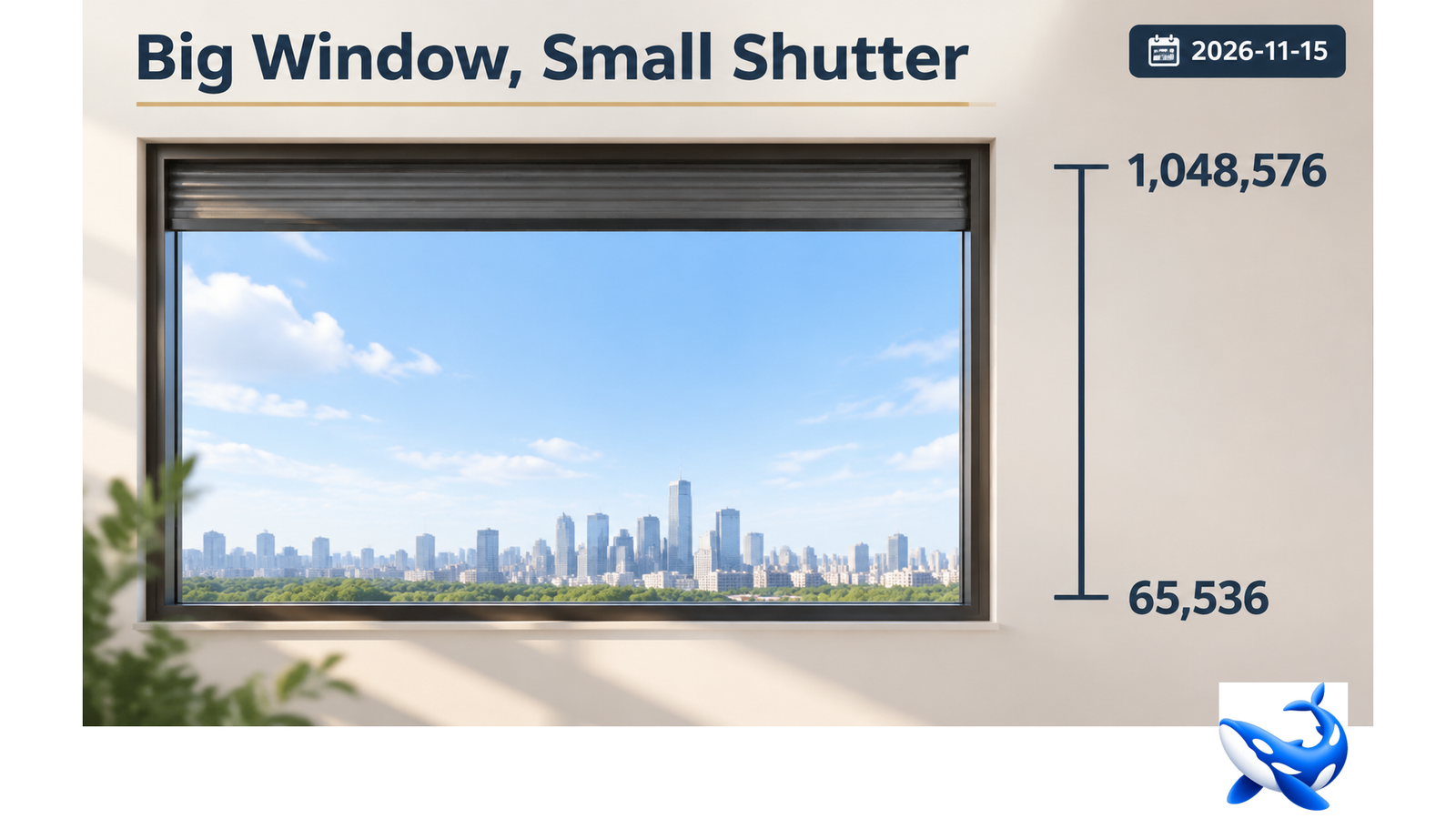
Of the eleven cards OrcaRouter lists on its cyber tier, the Hy4 abliterated API has the most lopsided window: 1,048,576 tokens in, at most 65,536 out, a ratio of one sixteenth [OURS].
Every published comparison of this card quotes the two numbers separately, and separately they look unremarkable. A million-token window is generous; 64K of output is normal. Put them in a ratio and a different card appears: one that is designed to read far more than it writes.
The two numbers side by side
The context window is how much input the model can hold. The output ceiling is how much it can produce in one response. Both are per-request limits, and neither is a billing constraint — you pay per token either way.
On most cards the two are related. A model with a small window usually has a small ceiling; a model with a huge window usually has a generous one. Hy4 breaks that pattern hard.
| card | context | output ceiling | ceiling as share of window |
| Kimi K3.1 Pro | 1,048,576 | 943,718 | 90.0% |
| Qwen3.8 Flash Next | 262,144 | 131,072 | 50.0% |
| MiniMax M3.1 Flash | 262,144 | 131,072 | 50.0% |
| DeepSeek V4.1 Flash | 1,048,576 | 393,216 | 37.5% |
| GLM 5.3 | 1,000,000 | 128,000 | 12.8% |
| GLM 5.3 Flash | 1,048,576 | 131,072 | 12.5% |
| MiMo V2.6 Flash | 1,048,576 | 131,072 | 12.5% |
| OrcaCyber Zero 1.0 | 1,000,000 | 128,000 | 12.8% |
| OrcaCyber Ultra 1.0 | 1,048,576 | 131,072 | 12.5% |
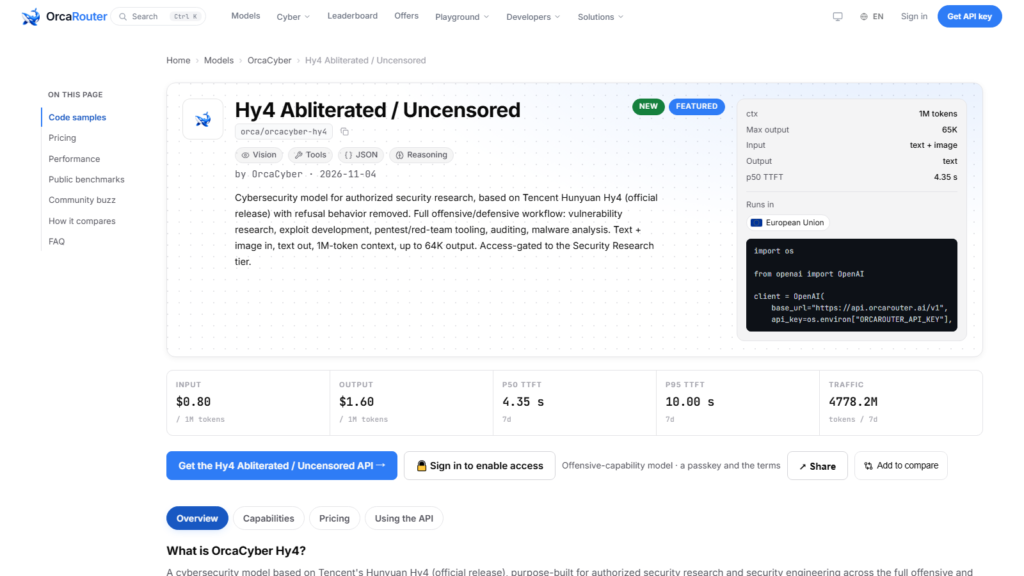
| Hy4 | 1,048,576 | 65,536 | 6.25% |
[OURS], read from each card’s public model data on 2026-11-15.
Kimi produces nine tenths of its window as output. Hy4 produces one sixteenth of it. That is not a small difference in degree — it is a difference in what the card is for.
Why the ratio matters more than either number
A 65,536-token ceiling is fine for almost any job, and so is a 262,144-token window. What breaks is the combination of a large input and a large output in the same call.
Take a task where the input and output are roughly the same size — a full file rewrite, a translation of a long document, a refactor that returns the whole file. On Hy4 that task is bounded by the *smaller* of the two numbers, and the smaller one is 65,536. The million-token window does nothing for you, because the response stops at 65,536 and the rest is silently gone.
On Kimi the same task is bounded at 943,718, which is fourteen times more headroom. On DeepSeek it is 393,216, six times.
So the ratio answers a question a spec sheet does not: how much of what I read can I write back? For a summariser, an extractor, a classifier or a triage step the answer never matters, because output is a fraction of input. For anything that transforms a document into a document, it is the whole decision.
How truncation actually shows up
The dangerous part of a ceiling is not that it exists. It is that hitting it is not an error.
A response that runs out of output budget comes back with a normal status, a normal body, and `finish_reason: “length”` — or, on the Responses and Messages shapes, an equivalent `incomplete` reason. The text you get is a valid prefix of what you asked for. A parser will accept it. A JSON decoder may even accept it if the truncation lands after a closing brace.
Three defences, in order of cheapness:
Check the finish reason on every call. It is one field. If it reads `length` more than a fraction of a percent of the time, the ceiling is biting and you should know before a downstream consumer does.
Validate the shape, not just the syntax. A truncated JSON object can be valid; a truncated one rarely has every key you expect. Assert on required fields rather than on successful parsing.
Log the output token count against the request. A distribution with a spike at 65,536 is a distribution that has been clipped. The spike is invisible if you only record averages.
Working above the ceiling
Three patterns, and they compose.
Map-reduce. Split the input into chunks that each produce an output under the ceiling, then run a second call over the outputs. A 200,000-token document becomes four 50,000-token chunks producing four 40,000-token summaries and one consolidation call. Costs more tokens in total; respects the limit.
Continue. Send the input plus the partial output and ask for the rest. This works and it is fragile, because the model has to be told exactly where it stopped and it will occasionally restart instead. Use it for prose, not for structured output.
Route by output size. This is the one that actually saves money. Most of a workload produces short output; a small fraction produces long output. Send the short fraction to the card with the best serving rows and the long fraction to the card with the biggest ceiling, and each call lands where it is cheapest.
The third is a routing decision, and it is the reason a tier with eleven cards beats a single model. Article 47 in this cluster works the pairings out in detail.
What the ceiling costs
Two costs, and only one is about tokens.
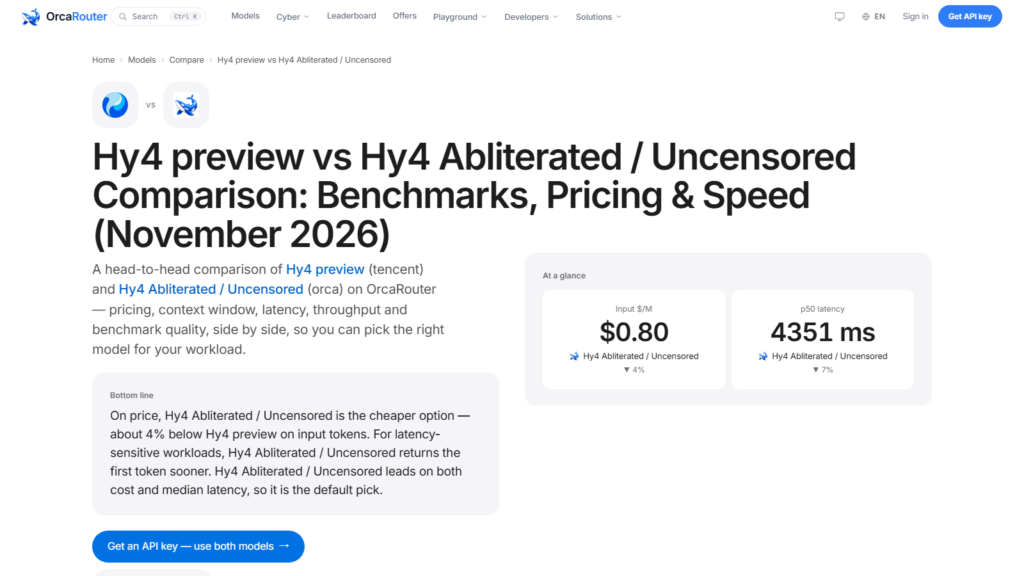
The first is retries. A clipped response has to be redone, and Hy4 generates at 173.7 tokens a second [OURS]. Re-running a 40,000-token response that got clipped at 65,536 costs about four minutes of generation, which is cheap in dollars and expensive in schedule if it happens nightly.
The second is the engineering. Chunking logic, continuation prompts and output-size routing are all code you would not write for a card with a 393,216 ceiling. That is a real cost and it is invisible on a price sheet.
Why the card’s ceiling is higher than its base’s
One detail worth noting because it runs the other way from most of the tier: the base checkpoint `tencent/hy4-preview` publishes a 64,000-token output ceiling, and the abliterated card publishes 65,536 [OURS].
The card is 1,536 tokens more generous than the checkpoint, which is 2.4%. The likely explanation is round numbers — 64,000 is a decimal round figure and 65,536 is a power of two, and whichever pipeline set the card’s limit used the binary value.
It matters only because it is easy to get backwards. On this tier the abliterated card is usually the smaller one: MiniMax’s card is a quarter of its base on both axes, and several others are a few percent under. Hy4 is the card that gained, and the gain is negligible — but a team that assumed “abliterated builds are smaller” would be wrong here, and wrong in the direction that makes the card look worse than it is.
The sizing test
One measurement, done once.
Take two weeks of your production requests, and for each one record the input tokens and the output tokens. Plot output against input. If the cloud sits well below the diagonal — output never more than a tenth of input — Hy4’s ratio is irrelevant and the card is a candidate on its serving rows alone.
If the cloud is spread along the diagonal, or has a thick band above a tenth, then a meaningful share of your calls will be clipped, and no amount of window makes up for it.
The test costs a fortnight of logging you should already have, and it converts a spec-sheet argument into a fact about your traffic.
What the ceiling is not
It is not a rate limit. There is no per-minute cap implied by 65,536; you can make as many calls as your key allows.
It is not a memory limit. The model does not forget earlier tokens at 65,536; the ceiling applies to what it writes, not what it reads.
It is not a quality signal. A small ceiling does not mean a weaker model — it means a model positioned for output that is short relative to its input, which is what most security work is.
The short version
65,536 against a 1,048,576-token window is one sixteenth — the tightest ratio in the tier, and the number to plan around rather than either figure alone.
It rules out document-to-document transforms in one call and rules out nothing else. Detection, extraction, classification and triage all sit far below it.
Check `finish_reason` on every call, validate output shape rather than syntax, and route the long-output fraction to a card with a 393,216 or 943,718-token ceiling. Those three habits make the limit a non-event.
Sourcing note: context windows, output ceilings, prices, latency, throughput, error rates, traffic and parameter surface are read from the eleven cards’ public model data on 2026-11-15, with seven-day windows ending that day [OURS]. The ceiling-to-window ratios and all cost arithmetic are our own. No benchmark rows are quoted in this piece.
